

Multigender definition
The multigender term can be used as an autonomous gender identity. Multigender people may view themselves as female, male, blending masculine and feminine identities, and/or any non-binary identities.
Multigender is also an umbrella term that includes many gender identities. The most common ones are the following: polygender, pangender, bigender, trigender, genderfluid. Some of the less common identities under the multigender umbrella term are: abigender, ambigender, quadgender, cyclogender, and demiflux.
Multigender individuals’ can choose masculine, feminine, gender-neutral, androgynous or any other gender expression (through appearance, clothing, body language). Their presentation may also shift and change over time.
The basics
The term "multigender" derives from the Latin word "multus" (much, many) + gender.
Multigender people may or may not desire to use hormone therapy and/or undergo a medical transition in order to change their bodies.
According to a 2015 survey conducted in the United States, 4% of respondents (more than 1000 people) self-identified as multigender.
So, what is the difference between multigender and polygender?
Multigender, as previously mentioned, is a term for an individual who describes themselves as having multiple genders, usually two or more.
Polygender is also a person who experiences multiple genders, not necessarily all of them.
Since these two terms are really similar, some individuals think that multigender is the same as polygender.
According to some other people, these two terms have different meanings.
In any case, some polygender individuals may also self-identify as multigender.
Multigender pride flags

The first flag was created by an unknown user. It has five horizontal stripes, from top to bottom, the colors are the following: blue, light blue, orange, light blue, blue. The blue and the light blue stand for a mixture of genders, and the orange, for genders that are outside the binary.

A Tumblr user duwang designed their version of the multigender flag in 2020. It has five horizontal stripes; from top to bottom, their colors are as follows: yellow, orange, purple, orange, yellow. The yellow color stands for gender(s) in general, the orange represents similar genders, and the purple symbolizes contrasting genders.
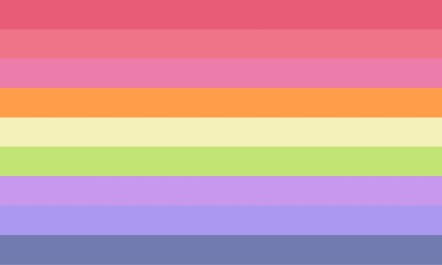
A user enbybro came up with his version of the flag in 2021. It has nine horizontal stripes; from top to bottom, the colors are: red, pink-red, pink, orange, yellow, green, purple, purple-blue, blue. The red stands for gender identities that are mostly and/or fully feminine, the pink-red, for partially feminine genders, the pink symbolizes genderless people. The orange represents unaligned gender identities, the yellow symbolizes static and fluctuating genders, the green stands for xenogenders. The purple represents multi-aligned gender identities, the purple-blue, partially masculine gender identities, and the blue, gender identities that tend to be mostly and/or fully masculine.
Multigender and sexual orientation

Gender identity is one’s concept of self as female or male (or a mix of them, both at the same time, neither, etc.), while sexual orientation involves an individual's feelings and sense of identity. Neither of the two phenomena is necessarily something that others can see.
Both gender identity and sexual orientation may remain the same throughout their lives or change over time.
A multigender person may be sexually attracted to men, women, transgender people, or individuals of any other non-binary identities.
What pronouns should be used?

Most multigender people prefer the universal, gender-neutral "they/them" pronouns. Some of them prefer neopronouns, some may even use binary pronouns. If you want to know what pronouns you should use when talking to a particular multigender person, there’s nothing to it - use whatever pronouns they tell you to use. If someone gives you more than one option, use them all.
Coming out as multigender
So you woke up to your new gender identity - multigender. Or it took you years to realize you’re a multigender. And you finally decided to tell your family, friends, or even followers on social media. But before you take this important step, read these useful tips on how to come out successfully and safely:
- Don’t push yourself, take your time - there’s no rush, you don’t have to tell everyone at once;
- For some individuals, it’s easier to write a letter or email first to express how they feel. If you’re one of them, you could do it just to take some of the pressure off, or actually give the written letter to the people you want to come out to;
- Find allies among your friends and/or in your family;
- Be prepared that some of your family members may not react to this exactly the way you expect, especially older people - they are not even used to non-binary terms, and they have been brought up in a different way, so extra patience might be needed for them;
- If someone reacts negatively and just refuses to accept this, try to not take it personally.
What is the best way to support multigender people?
Many multigender people are still are being oppressed socially and psychologically, and they have to deal with bullying or other forms of intolerance.
But together, we can stop gender-based discrimination and stigmatization. Here’s how you can support a multigender coworker, friend, or family member:
- Listen to them without prejudice, and if you notice you too have some subconscious bias, confront it, even if it is uncomfortable;
- Firmly believe that all people, regardless of gender identity, should be treated with dignity and respect;
- Let everybody know you find anti-multigender comments and jokes inappropriate, offensive, and harmful;
- Because we live in the digital era, thanks to the internet and social media, we can collect all the information we need; so learn more about multigender people and the issues they face to help them overcome these challenges.