

Xenogender gender identity
This gender identity is common among neurodivergent people, for example, autistic or any other individuals whose brain works differently than the majority of humans’.
Those who identify as xenogenders often say they feel like animals, creatures, plants. Some xenogender individuals may even perceive themselves as objects, feelings, sensations, songs, concepts, etc.
Xenogender is also an umbrella term for an entire category of non-binary genders that have nothing to do with "female" or "male". Here are the gender identities that fall under this umbrella:
- Abimegender (from French abîme (“abyss”) + gender) - a gender identity where an individual feels their gender in a profound and infinite way;
- Aesthetgender or Aesthetigender (from aesthetic + gender) - a gender experience that is the embodiment of something aesthetic;
- Aliengender (alien + gender) - a gender identity that is an interpretation of a gender/genders from a non-human perspective;
- Astralgender (from Latin astrum (“star”) + gender) - a gender identity where an individual feels deeply connected to space;
- Astrumgender (also from Latin astrum (“star”) + gender) - a gender identity that feels connected to stars and constellations;
- Caelgender - a gender identity that shares qualities with outer space, nebulae, stars;
- Catgender (also Felinegender, Kittengender, Kittygender) - a xenic gender where individuals strongly connect with or identify as cats or other felines;
- Contigender (from continuous + gender) - a gender identity that flows through time and space; it is always moving and constantly changing;
- Cosmicgender (from cosmic + gender) - a gender identity so vast and complex that its possibilities are infinite; it is similar to looking at the night sky through a telescope - one can only see a small part of it at a time;
- Dryadgender (from dryad, in the ancient Greek mythology, a nymph inhabiting a tree + gender) - a gender identity that is similar to agender but with a connection to an empty forest;
- Egogender (from Latin ego (“self”, “I” + gender) - a gender identity that is solely based on oneself; the only way to define it is calling it the “me gender”;
- Energender (from energy + gender) - a gender identity that is like a ball of energy - moving and shifting and rapidly, impossible to be pinned down;
- Ethergender (from ethereal + gender) - a dainty, delicate gender identity that cannot be quite explained;
- Gendervoid - a gender identity that consists of the void (originally it used to be a synonym of genderless);
- Niveigender (from Italian niveo (“snowy”) + gender) - a snowy, chill, light, soothing gender identity;
- Pyrogender (from Greek pyro (“fire”) + gender) - a gender identity that feels like fire;
- Staticgender - a gender identity that is like TV static - incomprehensible and fuzzy.
There is also another gender identity that is worth mentioning - the opposite of xenogender.
It is a gender identity per se and also an umbrella term; it is called anthrogender and means any gender that can be described in terms of how it is related (or not) to femininity, masculinity, or any other common human gender. Individuals who perceive themselves as bigender or multigender can be both anthrogender and xenogender simultaneously.
The basics
The word xenogender was coined in 2014 by the Tumblr user Baaphomett who submitted the term to the MOGAI-Archive blog. It derives from "xeno" (from the Greek xénos, meaning “alien, stranger, guest”) + “gender”.
According to the 2020 Worldwide Gender Census, 85 respondents (0.35%) said they identify as xenogender. Undoubtedly, this percentage is small. However, many other respondents said they identify as other genders falling under the xenogender umbrella (for example, 80 people said they were catgender).
Xenogender Visibility Day was established and first celebrated on May 15th, 2021.
Flag
There are several xenogender flag designs. The most popular one was created by the DeviantArt user Pastelmemer in 2015.

It consists of seven horizontal bands of equal widths. Their colors, from top to bottom, are the following: pastel pink, pastel pinkish-orange, pastel orange, pastel yellow, pastel blue, lilac, purple.
This flag also has a version with the astronomical sign for the asteroid Iris, a Greek goddess of rainbows:
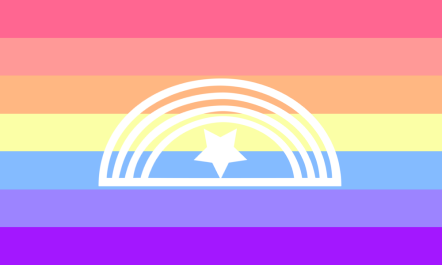
Another version of the xenogender flag has 5 stripes of the same colors:

The xenogender symbol in the center is an emblem in white color that consists of an upside-down five-point star inside four arcs symbolizing the rainbow whose bottom parts are connected by a horizontal bar:

Xenogender and sexual orientation
Gender identity is the inner sense of one’s own gender. Sexual orientation is an individual’s enduring pattern of romantic/sexual/emotional attraction to other people.
Xenogenders, just like anyone else, can be homosexual, straight, sexually attracted to people of any gender, or not attracted to anyone at all.
What pronouns should I use when talking to a xenogender?

Some xenogender people use the “they/them/their” gender-neutral pronouns that have already become traditional. Some others prefer neopronouns like xe/xem/xyr, ve/ver/vis, per/per/pers, etc.
The best way to know what their preferred pronouns are is to ask your xenogender interlocutor.
Coming out as xenogender
Some individuals choose to come out to just one close friend. It might be due to different reasons - because they do not feel the need to tell everyone, or because they do not feel safe telling some people, knowing that their views on gender are outdated. Some individuals who have identified as xenogender prefer not to come out at all.
If you think it is safe for you to come out but you are not sure how to do it, you might find these tips helpful:
- Not everybody feels anxious about coming out, but if you do, it is perfectly normal; remember you are not alone - many people have been through this process and there is a lot of information and support out there to help you plan what to say and how to say it;
- Come out to someone you trust first (your best friend or a family member who you know will always be supportive of you no matter what), and then eventually tell others;
- While you might think the most "natural" way to come out is to tell everyone in person, it is okay to choose to come out via email, text, by posting on social media - you and only you decide what you feel most comfortable with;
- Be positive but at the same time, be prepared for negative reactions too - some people might be shocked or find it difficult to accept (they will not necessarily feel that way forever though).
How can I support my xenogender friends, coworkers, family?
The good news is that together, we can change it and make our world a safer and more affirming place for everyone. Here is what you can do to show your support to xenogender people:
- Listen to your xenogender friend or coworker when they share their stories with you, show the highest levels of empathy and respect;
- Speak up whenever someone makes a comment or joke that is offensive to xenogender people;
- Encourage your family and friends to be LGBTQIA+ allies and stand up for their rights;
- Go to events that are important to xenogender people you know and donate to LGBTQIA+ organizations.